Showing posts with label cortex A9. Show all posts

[Unboxing & First Look]Star S1 5.3 " qHD 4.1 Jellybean Dual Core 1ghz

Wednesday, 16 January 2013

As we mention before on our blog post before this that Star Mobile Group are introducing their all new Star S1.We manage to have the phone for review purposes.
Below are the video of unboxing and the first look of the white version of the awesome budget friendly device.We will post a full review on the consumer feedback as well as tips to get the best out of the smartphone itself.
Do remember to like us on Facebook as well as GizmoAsia Facebook Page and Youtube Channel


NEWS STE unveils NovaThor L8580 chipset with quad-core A9 CPU

Thursday, 10 January 2013

If you're the benchmark-obsessed geek than CES 2013 might be turning out quite exciting for you.
After Samsung unveiled its latest and greatest Exynos 5 Octa chipset, NVIDIA announced Tegra 4 and Qualcomm lifted the curtain of its newest Krait-powered Snapdragon 600 and 800 series SoCs, it's now ST-Ericsson's turn to stand in the spotlight. The company just announced its latest NovaThor chipset - the L8580.
It comes with a low-power eQuad processor with four Cortext-A9 cores, clocked at up to 2.5 GHz, the PowerVR SGS544 GPU and the ability to go low-power and run at 0.6V.
The NovaThor L8580 can deal with 1080p video and support display resolutions of up to 1920 x 1200 pixels. 20MP primary cameras and 5 MP secondary ones are allowed too and there's built-in LTE HSPA+, TD-SCDMA and EDGE radios. 3D reproduction and capture is also on board if that's your thing.

FEATURES

  • Full HD 1080p camcorder, multiple codecs supported (H264 HP, VC-1, MPEG-4)
  • 3D HD video capture and display
  • High-resolution, touchscreen display support up to WUXGA
  • Simultaneous dual display support up to dual qHD
  • High-performance 3D graphics
  • Dual camera support up to 20 Mpixel and 5 Mpixel
  • Wi-Fi, Bluetooth, GNSS (GPS+GLONASS), FM and NFC enabled platform
  • Built-in USB 2.0, HDMI out
  • Optional support for mobile TV standards

TELECOM

  • LTE FDD/TDD, HSPA+, TD-SCDMA, EDGE
  • Radio supporting up to 10 LTE/WCDMA/GSM bands.
  • Power efficient architecture
  • Highly integrated radio solution

TECHNOLOGY

  • Super fast, low-power eQuad processor clocked at up to 2.5Ghz based on ARM® Cortex™- A9 processor 
  • Dual multimedia DSP for low-power, flexible media processing
  • High-bandwidth Dual LP-DDR2 interface
  • Imagination Technologies POWERVR™ SGX544 GPU
  • Unique audio architecture with a wide range of audio codecs supported
  • Advanced power saving architecture enabling class-leading audio and video playback time

The ST-Ericsson L8580 chipset should allow the creation of affordable mid-range devices with excellent processing power and good battery life. The top shelf smartphones and tablets will move on to Cortex-A15 architecture this year, but there's plenty of ground below them for the NovaThor L8580 to cover.
Source | Via

Closer look at FXI Cotton Candy’s $199 any-screen computer

Saturday, 17 November 2012

The FXI Cotton Candy is a tiny computer that’s about the size of a USB flash drive. One one side is a USB port, and on the other is an HDMI connector. And in between there’s a 1.2 GHz Samsung Exynos 4210 dual-core processor, 1GB of RAM, and ARM Mali 400 graphics.
It’s been a little over a year since FXI first introduced the Cotton Candy, and in that time we’ve seen dozens of cheap Android devices that you can plug into a television, some costing less than $50. But FXI charges $199 for the Cotton Candy.
I caught up with FXI CEO Borgar Ljosland recently and had a chance to ask him what sets the Cotton Candy apart.

Surprisingly, Ljosland actually seemed excited when I brought up the competition. That’s because they’re helping to popularize the idea of a portable device that you can plug into any TV to run Android apps on a big screen.
But the Cotton Candy does a few things that most of those devices don’t.
First, FXI calls its device an “any screen” computer. That’s because it doesn’t just work with televisions or monitors. You can also plug it into a Mac, Windows, or Linux computer to run Android apps on a PC. Sort of.
What actually happens is that the computer treats the Cotton Candy as a standard USB drive. But on that drive there are apps for OS X, Linux, and Windows that launch virtualization software, letting you basically login remotely to the Cotton Candy without leaving your desktop environment.
In other words, it’s still that Exynos processor and Mali Graphics chip that’s doing the heavy lifting, not your computer’s processor. Any apps you’re using are runnin on the stick. But you’ll see them in a window on your computer. The process is pretty seamless and Android apps looked pretty responsive in the Mac and Windows computers Ljosland showed me.
Another thing that helps set the Cotton Candy apart is that it’s not limited to running Android. We’ve seen plenty of independent developers port Ubuntu and other Linux distributions to run on cheap mini PCs like the MK802. But FXI officially supports Ubuntu as well as Android 4.0.
So if you buy an FXI Cotton Candy stick, you have a choice of using it to run Ubuntu or Android. Right now that means Android 4.0 or Ubuntu 12.04, although FXI could release updates for either operating system… or independent developers could do the same.
Right now, Ljosland says there are 160 different companies trying out the Cotton Candy, either to see if they can use it in their businesses or to develop applications that run on top of it.
At this point, the company is targeting the device at developers, which is another reason for the $199 price tag. Anyone can pick up the stick-sized-computer and use it for non-development purposes, but it’s not really meant to be a consumer device just yet.
On the other hand, if you’re a company with a large number of employers that may need to use different computers at different locations, this sort of solution would let you give each user a computer that they can fit in their pocket. It would store all of their files, settings, and apps, and they could pick up where they left off by plugging the device into any PC or display.
FXI Cotton Candy
Ljosland also seems convinced that the Cotton Candy offers better performance than many of the cheap Chinese sticks we’ve seen, but that’s probably a matter that’s up for debate. It basically has the same guts as a Samsung Galaxy S II smartphone, which is a bit dated at this point.
The stick features WiFi and Bluetooth support and FXI ships it with an 8GB microSD card — which is the only storage the Cotton Candy has. There’s no built-in storage space.
Here’s a recap of what you get with the $199 Cotton Candy stick:
  • 1.2 GHz Samsung Exynos 4210 dual core ARM Cortex-A9 processor
  • quad-core ARM Mali 400 graphics
  • 1GB RAM
  • microSD card slot for up to 64GB of storage
  • 802.11b/g/n WiFi
  • Bluetooth 2.1
  • USB 2.0 male port
  • HDMI port
  • micro USB port
You can keep up with the software development, and see more of what people are doing with the Cotton Candy in the FXI forums.

News : Huawei debuts 5-inch Ascend D2, quad-core and Jelly Bean in tow

Tuesday, 30 October 2012


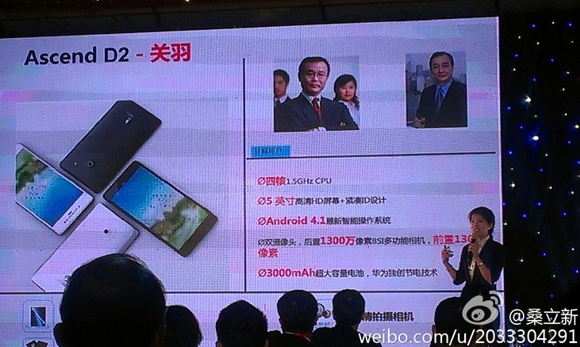
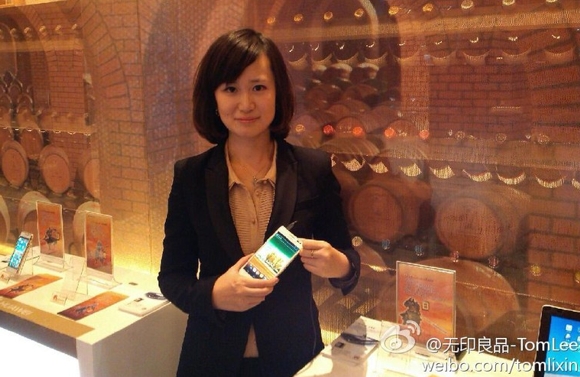
Huawei is the latest manufacturer to join in the phablet race and it sets its sights on the Galaxy Note II, Oppo Find 5, Optimus Vu and the Pantech Vega R3. The company just unveiled the Ascend D2 and it's been showcased in China and promised to bring it to the (local) market in early 2013.


The highlights of the Huawei Ascend D2's specs sheet include a 5" screen of an unknown resolution, a quad-core processor with four 1.5 GHz cores (probably the home-backed K3V), a 13 MP snapper on the back and Android 4.1 Jelly Bean installed. There's also a 1.3 MP front-facing camera and 3000 mAh battery.


News : Samsung I9260 Galaxy Premier GLBenchmark scores reveal GPU

Tuesday, 23 October 2012


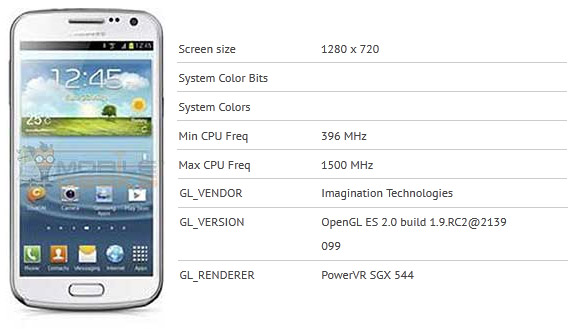
The Samsung I9260 Galaxy Premier was once rumored as the next Galaxy Nexus phone, but those rumors were renounced. The Premier sits somewhere between the Galaxy S III and the S III mini and now we know its GPU (and most likely chipset) thanks to a GLBenchmark score.
GLBenchmark reports Android 4.1.1 Jelly Bean and 720p resolution (that's exactly 1280 x 720 pixels, which confirms there won't be on-screen controls). The CPU max frequency is listed as 1.5GHz and while the number of cores was left out, the rumors point to a dual-core processor.
The GPU is a PowerVR SGX 544, very similar to the SGX543 found in Apple's latest chipsets. All of this - plus some AnTuTu scores from last week - point to a TI OMAP 4470 chipset (recently used in Amazon's Kindle Fire HD 8.9 tablet).


This means the I9260 Galaxy Premier has two Cortex-A9 cores, probably 1GB of RAM and the SGX544 GPU. Other Android chipset makers rely on Mali (Samsung's Exynos), GeForce (Tegra) or Adreno (Qualcomm), which leave Texas Instruments.
We know it's not a Cortex-A15 packing OMAP 5 chipset (which has a dual-core CPU and SGX544 too), because the AnTuTu CPU scores are below those of the HTC One S and its two Krait cores.
Anyway, the Galaxy Premier is not going to dethrone the Galaxy S III, but it does look more temtping than the NovaThor-packing Galaxy S III mini. We're still waiting for the Samsung I9260 Galaxy Premier to be officially announced.
Source | Via

News : FXI Cotton Candy $199 PC-on-a-stick hits general availability

Thursday, 4 October 2012

The FXI Cotton Candy is a tiny computer with an ARM Cortex-A9 processor, Mali 400 graphics, and Android 4.0 software. It’s been in development for almost a year, and last week FXI started shipping the little PC-on-a-stick to customers that had pre-ordered.
Now the Cotton Candy store is officially open to the public, and anyone who wants to spend $199 on the little computer can pick one up.
FXI Cotton Candy
FXI cautions that the software is still a beta release meant for developers. Right now there’s no access to the Google Play Store, power management isn’t implemented, and video playback only works for certain video formats.
Future software updates will fix some of those issues, but if you’re looking for a fully functional USB flash drive-sized Android computer, there are better (and cheaper) options available right now, including the UG802 or G-Box Dyno.
But the Cotton Candy has a few features that those devices lack. First, it’s aimed at developers, and FXI offers an optional debug board accessory for $69. Second, the Cotton Candy includes software that lets you plug the stick into a Windows, Mac, or Linux computer to apps in an Android environment on your PC.
FXI Cotton Candy with Mac
So you can use the Cotton Candy as a standalone device by connecting a keyboard, mouse, and television. But you can also use it as a portable operating system on a stick that you can plug into nearly any computer.
The Cotton Candy has a 1.2 GHz ARM Cortex-A9 CPU, 1GB of RAM, a microSD card slot for storage, 802.11b/g/n WiFi, Bluetooth 2.1, a USB 2.0 port, a micro USB 2.0 port, and an HDMI port.
In addition to the Google Android build for the Cotton Candy, the device should be able to run Ubuntu or other Linux-based operating systems once they’re ported to run on the hardware.

Review: $69 G-Box Dyno Android 4.0 mini PC with ARM Cortex-A9

Thursday, 27 September 2012

The G-Box Dyno is tiny desktop computer that sits in the palm of your hand. It’s got the guts of an Android smartphone or tablet, but it doesn’t have a display or touchscreen. Instead you plug in a keyboard, mouse, remote control, and TV or monitor to run Android apps on a big screen.
G-Box Dyno Mini PC
At first glance the G-Box Dyno looks nearly identical to the MK802 Android 4.0 Mini PC that was released earlier this year. But the Dyno has a faster processor, better ventilation, and comes with a remote control. And it sells for just $69 (or less).
The folks at Android TV Box sent me a unit to review. Here are some initial impressions.
The PC-on-a-stick features an Amlogic AML8726-MX ARM Cortex-A9 processor. That’s the same chip used in Diamond Multimedia AMP1000, although the G-Box Dyno costs sells for just over half the price of that media player.
It features 1GB of RAM, 4GB of built-in storage, a microSD card slot for extra storage, 802.11b/g/n WiFi, HDMI output, a full-sized USB port, and a mini USB port.
The mini PC comes with an HDMI cable, power cable, and an infrared remote control which you can use to navigate through the Android user interface even if you don’t plug in a keyboard or mouse.
The remote has arrow buttons, volume keys, an OK/select button, and Android keys for basic functions including home, back, zoom, and opening the app drawer.
The G-Box Dyno comes with Android 4.0 Ice Cream Sandwich and ships with a custom app launcher which bears a more-than-passing resemblance toMicrosoft Bob. It offers quick and not particularly intuitive shortcuts to the web browser, media apps, file browser, and settings.
Unlike some Android mini PCs I’ve seen recently, the G-Box Dyno does not come pre-rooted, so if you want root access to files, folders, and settings, you’ll need to find a way to root the device yourself.
Fortunately the device also includes a more standard Android launcher app if you want to customize the home screen with the app icons and widgets that you use most often. You can also download and install third party app launchers from the Google Play Store, because the Dyno comes with Google’s app store preloaded.
The Amlogic processor is significantly faster than the Allwinner A10 ARM Cortex-A8 chip in the MK802, and the new device feels much more responsive than that little computer.
It probably also helps that the Dyno also has 1GB of RAM, while the MK802 on my desk has just 512MB (I bought it before 1GB models were available).
On the other hand, while I’ve never had problems picking up a WiFi signal on the MK802, the G-Box Dyno is a little more finicky. My router is in the first floor of our house, while my office is on the third floor. Sometimes the Dyno noticed the router, sometimes it didn’t. In order to get online, I had to enable the mobile hotspot feature on my phone to share my 3G connection.
While you can use the Dyno as a little Android powered computer, it’s designed to be used as a TV companion. It comes with a pre-release version of the XBMC media center application for Android. The user interface is pretty snappy, and it can handle video playback reasonably well.
I wasn’t able to get the Netflix app from the Google Play Store to function at all, but I had more luck once I installed Diamond Multimedia’s build for the AMP1000 media player. The user interface is very sluggish, but once videos start playing they look fine.
The official YouTube app force closed whenever I tried to open it.
I’ll be trying out more apps on the G-Box Dyno in the coming weeks, and keeping an eye out for third party development. I’m interested to see if anyone manages to get Ubuntu or other Linux-based operating systems up and running on this type of hardware.
But despite the goofy custom app launcher and mediocre WiFi performance, I could certainly think of worse ways to spend $69. The G-Box Dyno certainly isn’t the best little internet TV box money could buy, but for the price it’d be tough to find one that’s quite this versatile.

Review #Ainol Novo 7 Crystal Jelly Bean 4.1 Tablet


Ainol launched a Jelly Bean tablet – Ainol Novo 7 Crystal. It boasts an HD MVA 7" mult-touch screen (ultra-clear) and Dual Core 1.5Ghz Cpu. This is the new upgrade (MVA screen) replacement to discontinued Novo 7 Elf II.  Below the hood is an Amlogic 8726-M6 Cortex A9 processor, a Mali 400 GPU, 1GB of RAM and 8GB of internal storage. The 7-inch touchscreen display sports a 1024 x 600 resolution, and Ainol chose an IPS panel for wide viewing angles. The tablet will be available in black and white.
ainol-novo-7-crystal

Features:

Model: Ainol NOVO7 Crystal 
CPU: 2nd generation ARM Cortex-A9 based AMLogic 8726-M6 1.5GHz CPU 
GPU: Dual-Core Mali-400 
Operation System: Google Android 4.1 Jelly Bean
RAM: 1GB DDR3 
Nand Flash: 8GB(Android System consumes about 2.2GB) 
Shell Material: Plastic 
Screen Size: 7 Inch 
Type: Capacitive Screen (5 points) 
Screen Resolution: 1024 x 600 IPS screen 
Extend Card: Support TF card up to 16GB (Not includes) 
Camera: Yes, 2.0MP Front Camera. 
Gravity Sensor: Yes 
Multi-Touch : Yes, 5 points touch 
Flash: Yes 
Video: AVI/MOV/MP4/RMVB/FLV/MKV (more format supported via 3th party player such as rock player) 
Music: MP3/WMA/WAV/APE/AAC/FLAC/OGG 
Ebook: TXT, PDF, HTML, RTF, FB2 
Email and Browser: Yes, built in 
WIFI: 802.11 b/g/n 
Earphone Interface: 3.5mm 
Battery: 3700mAh 
Language: Indonesia, Dansk, Deutsch, Chinese, English, Spanish, Germany, Italian, French, Latvia, Malay, Nederlands, Poland, Romania, Russian, Greek etc. 
Other Applications : Office, Browser, Gallery, Clock, Calculator, Calendar, Gmail; 
Product Size: 189.3x120x11.2mm

Review : Kimdecent Droid $72 Stick T10 mini PC: Android 4.1 and a Rockchip RK3066 CPU

Saturday, 22 September 2012

Kimdecent’s latest Android mini PC is a USB thumb drive-sized computer-on-a-stick with a dual core ARM Cortex-A9 processor, 1GB of RAM, 8GB of storage, and Android 4.1 Jelly Bean software.
It’s called the Kimdecent Droid Stick T10, and you can pick one up from AliExpress for $72.
Kimdecent Droid Stick T10
This isn’t the first Android Mini PC we’ve seen, or the first with a Rockchip RK3066 processor. But it is the first RK3066 model I’ve seen to ship with Android 4.1.
The little computer has ARM Mali 400 graphics. It also has a full-sized USB 2.0 port, 2 mini USB ports, a micro SD card slot and an HDMI port, so you can plug in a display, keyboard, mouse, remote control dongle, or other peripherals to run Android apps on a TV or monitor.
It also features 802.11b/g/n WiFi and comes with the Google Play Store built-in. The spec sheet also says it runs Adobe Flash Player 11, despite the fact that Adobe doesn’t officially support Android 4.1.
Unfortunately Rockchip offers little to no support for Linux, which means that it’s unlikely we’ll see a fully functional version of Ubuntu, Fedora, or other desktop Linux operating systems ported to this device anytime soon.

Samsung guns at the iPhone 5 in its latest Galaxy S III ad

Sunday, 16 September 2012

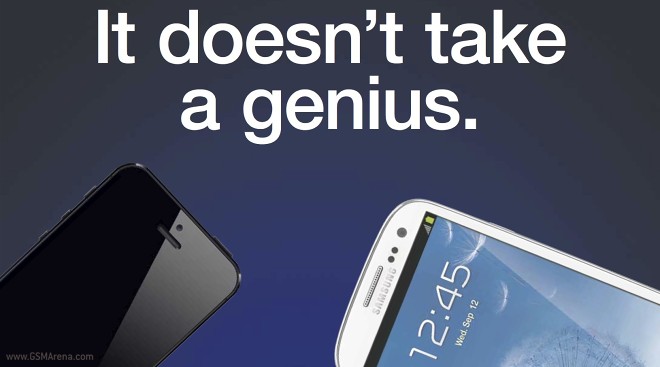
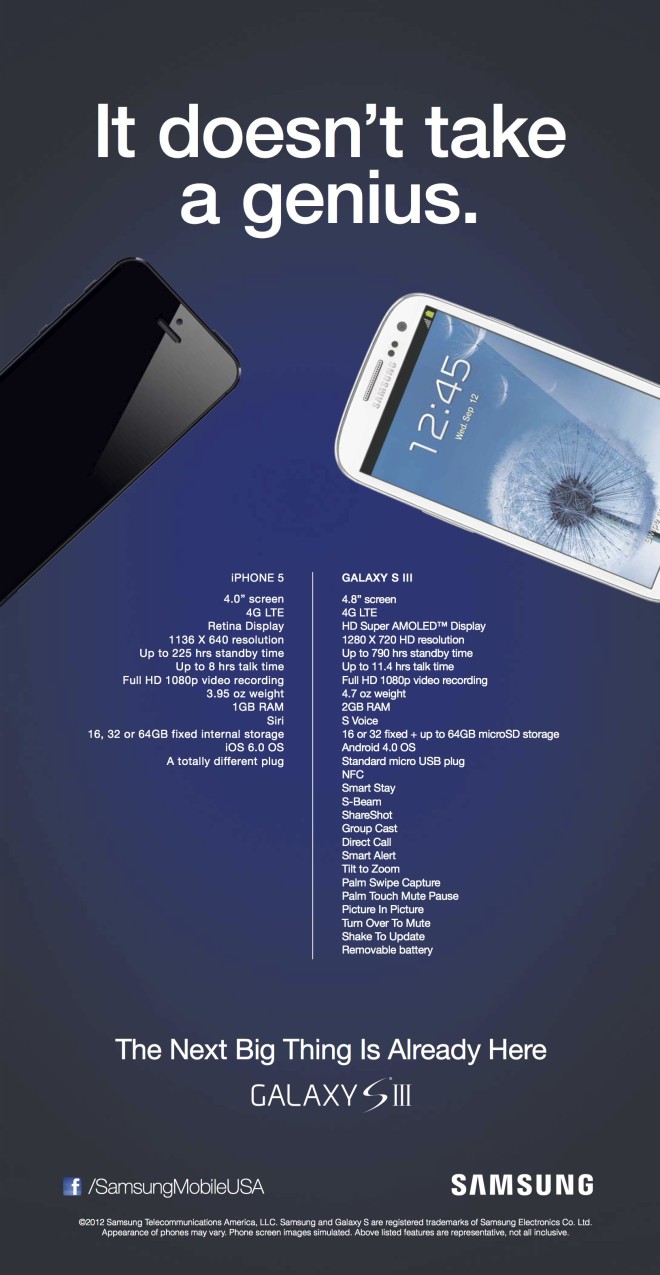
Well, that one surely didn’t take long, guys! With the world still gushing with emotions over the Apple iPhone 5 launch, Samsung released an ad for its Galaxy S III smartphone, which aims right at Apple’s latest and greatest offering.
Under the slogan you see above, which gently (or not?) refers to the employees in the Apple stores, Samsung have listed a spec for spec comparison between the US Galaxy S III and the iPhone 5.
We are particularly impressed with the “totally different port” reference for iPhone 5′s spanking new Lightning connector. As for the software side of both phones – Samsung have gone out of their way to point all the tricks, which their US flagship possesses.
Here goes the ad itself. As always, you are welcome to share your take on it in the comments section.
Source | Via

News: Motorola DROID RAZR HD developer edition gets outed

Saturday, 15 September 2012

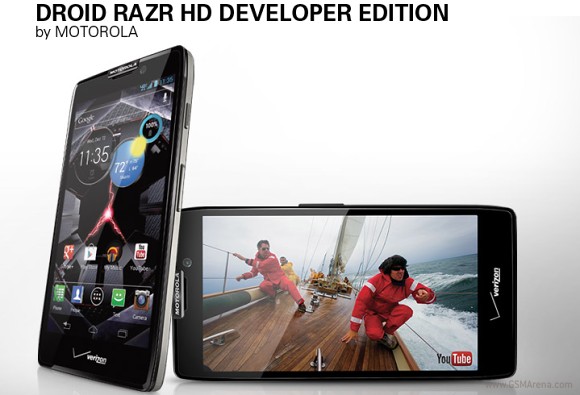
In a quiet fashion Motorola has released a developer edition of its latest and greatest DROID RAZR HD smartphone, sporting a bootloader which can be unlocked. The handset is destined for users with a knack for flashing custom ROMs, as well as those who don't like Verizon's take on Android.


There is no release date set for the headset. A sign up page however is up and running for the overly anxious. Expect a hefty price tag and lack of warranty when the Motorola DROID RAZR HD Developer Edition becomes available.

News #Ainol Novo 7 Crystal: $120 tablet with Android 4.1, Amlogic 8726

Saturday, 8 September 2012

The Pipo U1 isn’t the only cheap Android 4.1 tablet with a dual core ARM Cortex-A9 CPU. Ainol has introduced a new 7 inch tablet powered by a 1.5 GHz Amlogic AM8726-M6 dual core processor with Mali 400 graphics.
It’s called the Ainol Novo 7 Crystal. The tablet runs Android 4.1 Jelly Bean, and it’s available for purchase from a number of retailers for $120 or less.
Ainol Novo 7 Crystal
The tablet has a 1024 x 600 pixel capacitive touchscreen display with a 170 degree viewing angle. It has 1GB of RAM, and 8GB of storage, and a microSD card slot for extra storage.
The Ainol Novo 7 Crystal has a 2MP front-facing camera, 802.11b/g/n WiFi, a mini USB port and mini HDMI output.
The tablet makes the new $159 Amazon Kindle Fire look expensive — especially since Ainol says its tablet ships with the Google Play Store preloaded. You can always load the Amazon Appstore, MP3 store, and Kindle app yourself if you want to access content from Amazon’s stores.
On the other hand, the Ainol Novo 7 Crystal only promises up to 5 hours of battery life from a 3700mAh battery, which falls a few hours short of the run time you’d get from a Kindle Fire or Google Nexus 7.
Ainol’s latest tablet measures 7.4″ x 4.7″ x 0.4″ and weighs about 12 ounces.

News : Apple cuts back chip orders from Samsung, the war rages on

Friday, 7 September 2012

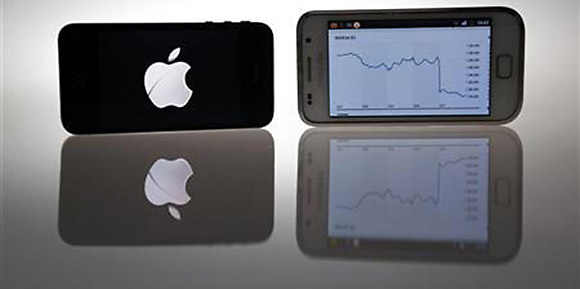
You are all aware of the recent major US patent lawsuit involving Apple and Samsung. So far their patent quarrels had not have any impact on their component supply deal, which has Samsung provide most of the memory chips that Apple uses in its mobile device.
According to Reuters and several other news outlets, all citing anonymous sources, with the iPhone 5, Apple is now steering away from Samsung as its main chip supplier. Instead, the company is looking to strengthen its supplies from competing chip manufacturers such as Toshiba, Elpida and Hynix.

Photo by Reuters

So what are we witnessing here? Is it that Apple is getting ready for a long war, or it's just that it doesn't like to do any further business with Samsung?
It could also be that Samsung is using its chip manufacturing deal as a leverage in their patent brawls across the world or just on the contrary, it's Apple that's using the cutting back of the orders as a leverage. Apple is supposedly Samsung’s largest components client with estimates pointing that their deal is supposedly bringing billions in yearly revenue. Well, we may never learn the truth.
Source | Via

Rumors : A Dual SIM Galaxy Note II in the works, leaks in China?

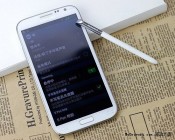
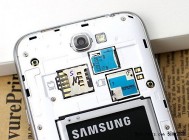
Dual SIM phones have never been high-end products so you can imagine our surprise when we first saw this leak. A dual SIM Galaxy Note II? Even for the Chinese market, this is really hard to believe. And yet, here we are with all this wonderful photo evidence.
Of course, this could as well be one of the very elaborate fakes China is known for. You never know with these things.
  
The Galaxy Note II as a Dual SIM phone
According the source, this here device is made specifically for China Unicom and has the same specs as the international Note II.

All You Need To Know About New Kindle Fire,Kindle Fire HD and Kindle Fire 4G[DX]

Thursday, 6 September 2012

Amazon isn’t just taking pre-orders for its new Kindle Fire and Kindle Fire HD tablets in the US. For the first time, the tablets are also available internationally. You can place orders with Amazon in France, Germany, Italy, Spain, and the UK.
Amazon Kindle Fire HD 7
The first two models to launch in those countries are the new Kindle Fire and the Kindle Fire HD 7. There’s no word on if or when we’ll see the Kindle Fire HD 8.9 or the Kindle Fire HD with 4G LTE in Europe.
Amazon is charging £129 for the Kindle Fire in the UK, and €159 in countries that use the Euro.
The Kindle Fire HD is going for £159 in the UK and €199 elsewhere. Those prices are a little higher in Europe than in the US, since Euros and pounds tend to be worth a bit more than dollars these days. But taxes are also generally higher in Europe as well.
With the launch of the new tablets in Europe, Amazon is also now opening the Appstore for Android apps in those countries, as well as offering digital books, music, movies, and other content.
Interestingly, the new Kindle and Kindle Paperlight eReaders aren’t yet available for purchase from Amazon’s European stores.
 the prices for tablets with “special offers.”
Amazon Kindle Fire HD 8.9
Amazon has been using advertising to subsidize the price of its E Ink Kindle eBook readers since last year. But this is the first time the company is bringing ads tot he lock screen of its color Android-based tablets.
Since the ads will only show up on the lock screen, you’ll only see them when you tap the power button on your device. Once you slide to unlock, they’ll go away.
Amazon has decided to enter the $499 tablet space by offering a tablet with an HD display, 32GB of storage, and 4G LTE wireless data. While it’s the most expensive Kindle Fire tablet, the Kindle Fire HD with 4G LTE is also one of the cheapest tablets available with 4G — especially when you factor in the cost of a data plan.
Amazon has announced that for $49.99 per year, customers will be able to use up to 250MB of data per month. They’ll also get 20GB of online storage, and a $10 Amazon appstore credit.
In other words, over the course of a year, you can pick up a Kindle Fire HD and use the 4G service and pay just $549. A 32GB Apple iPad 3 with 4G LTE, but no data plan costs $729.
4G service will be provided by AT&T, and Amazon says customers will also be able to upgrade to data plans with 3GB or 5GB of data per month… but pricing for those plans hasn’t yet been revealed.
Of course, 250MB isn’t all that much data. I’ll be curious to see what other plans are available for heavier data users — but if you plan to use your tablet mostly around the house or in other locations with WiFi, but want to be able to check your email on the go, this is a pretty fantastic price.
Amazon Kindle Fire 4G
You can order the 7 inch model starting today for $199. It will ship September 14th. The 8.9 inch tablet goes up for pre-order today for $299, and ships starting November 20th.
Amazon Kindle Fire HD 8.9
The 8.9 inch model has a 1920 x 1200 pixel IPS display with 254 pixels per inch. Amazon says it also reflects 25 percent less glare thanks to improved screen technology.
The 7 inch tablet has a 1280 x 800 pixel screen. Amazon says this model will get 11 hours of battery life, although a battery life claim for the larger model is curiously absent.
Since HD video takes up more space than standard definition, Amazon is increasing the amount of storage available. The Kindle Fire HD will be available in 16GB, 32GB, and 64GB varieties.
The Kindle Fire HD tablets feature TI OMAP 4470 dual core processors, offering percent better performance than the chip in the original Kindle Fire — and Amazon claims it also faster than the NVIDA Tegra 3 quad-core chip (at least in terms of memory bandwidth… which is one way to measure things, I suppose).
Amazon Kindle Fire HD 7
The new tablets have dual stereo speakers, Dolby Digital Plus audio, two antennas and other upgrades to improve WiFi performance. There’s also a front-facing HD camera.
The tablets also feature HDMI output, WiFi, and Bluetooth — which is a big step up from the original Kindle fire, which had WiFi but no Bluetooth or HDMI.
Amazon is also introducing new software features including WhisperSync for voice, which lets you listen to audiobooks and pick up reading where you left off with a text book. And there’s a new X-Ray for movies feature which lets you view IMDB data for a movie as you’re watching. Want to know who an actor is? You can look it up while you’re watching a video.
WhisperSync for Games lets you save your game progress and synchronize it across devices — so you can start playing a game and continue from the same level on another device. That’s something that’s been sorely missing from the Android smartphone and tablet experience to date.
The Kindle Fire tablets are also getting a new email client with support for Gmail, Hotmail, Yahoo, and Exchange. It can also sync your calendar and contact data.
With starting prices of $199, the new Kindle Fire HD tablets may have out-done the Google Nexus 7 in the spec department. The 7 inch model has Bluetooth and HDMI, which the Nexus 7 lacks. It also has 16GB of storage, which is twice what you get with Google’s tablet.
Of course, the Google Nexus 7 also includes a quad-core NVIDIA Tegra 3 chip, Android 4.1 Jelly Bean software and support for the Google Play Store with access to hundreds of thousands of apps (the Amazon Appstore has just 50,000). But Amazon’s making a pretty compelling case for its tablet with Whispersync for games, videos, and more, and Amazon already has the better book, movie, and music stores.


DroidXDA © 2012 | Designed by Bubble Shooter