Showing posts with label Benchmark. Show all posts

News : Samsung I9260 Galaxy Premier GLBenchmark scores reveal GPU

Tuesday, 23 October 2012


The Samsung I9260 Galaxy Premier was once rumored as the next Galaxy Nexus phone, but those rumors were renounced. The Premier sits somewhere between the Galaxy S III and the S III mini and now we know its GPU (and most likely chipset) thanks to a GLBenchmark score.
GLBenchmark reports Android 4.1.1 Jelly Bean and 720p resolution (that's exactly 1280 x 720 pixels, which confirms there won't be on-screen controls). The CPU max frequency is listed as 1.5GHz and while the number of cores was left out, the rumors point to a dual-core processor.
The GPU is a PowerVR SGX 544, very similar to the SGX543 found in Apple's latest chipsets. All of this - plus some AnTuTu scores from last week - point to a TI OMAP 4470 chipset (recently used in Amazon's Kindle Fire HD 8.9 tablet).
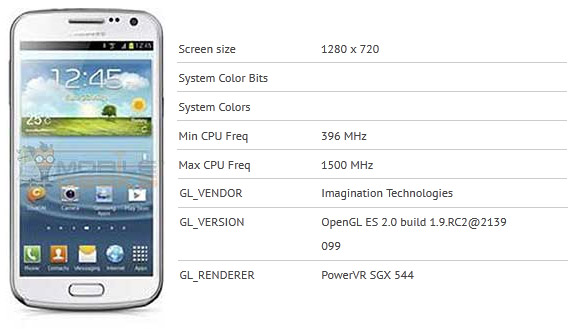

This means the I9260 Galaxy Premier has two Cortex-A9 cores, probably 1GB of RAM and the SGX544 GPU. Other Android chipset makers rely on Mali (Samsung's Exynos), GeForce (Tegra) or Adreno (Qualcomm), which leave Texas Instruments.
We know it's not a Cortex-A15 packing OMAP 5 chipset (which has a dual-core CPU and SGX544 too), because the AnTuTu CPU scores are below those of the HTC One S and its two Krait cores.
Anyway, the Galaxy Premier is not going to dethrone the Galaxy S III, but it does look more temtping than the NovaThor-packing Galaxy S III mini. We're still waiting for the Samsung I9260 Galaxy Premier to be officially announced.
Source | Via

Freescale i.MX6 quad-core CPU benchmarks (Ampe A10 tablet)

Wednesday, 17 October 2012

Freescale’s i.MX6 Quad processor is a 1.2 GHz quad-core chip with support 1080p HD video playback and 3D graphics. Tablets and other devices with the chip started shipping recently, and the folks at PandaWill sent me an Ampe A10 tablet with an i.MX6 processor to review.
I’ll have mode details on the tablet soon (it’s a mixed bag — with at least one dead pixel and a bubble under the screen — but a pretty zippy processor and decent looking design). But for now I wanted to share some preliminary benchmarks. Keep in mind, RAM, storage, and other components also play a role in benchmark results, so not all i.MX6 devices will get identical scores.
Freescale i.MX6 (Ampe A10 tablet) benchmarks
The Amp A10 has a 1280 x 800 pixel display, 1GB of RAM, 16GB of storage, HDMI, WiFi, and Bluetooth. It features the Vivante GC2000 graphics engine and ships with Google Android 4.0.4.
There are a number of popular benchmarking utilities for Google Android. Some of the best look at overall CPU and graphics performance. While they don’t always tell you much about how a tablet will perform in day-to-day usage, they do at least help you get an idea of which tablets are generally faster than others.
If you take a look at the chart above, you’ll see that I pitted the Ampe A10 tablet against a Google Nexus 7 (with a 1.2 GHz NVIDIA Tegra 3 quad-core processor), and the B&N NOOK Tablet (with a 1 GHz TI OMAP 4430 CPU).
In 2 out of 3 tests, the Ampe A10 trailed the Nexus 7… but not by very much. In Quadrant, the Ampe A10 actually came out ahead… but again, not by a very large margin.
Both of those tablets trounced the NOOK Tablet in all tests. And the NOOK Tablet isn’t exactly a sluggish tablet by any means.
Freescale i.MX6 SunSpider
I saw similar results in the SunSpider web-based benchmark which looks at JavaScript performance. For this test, lower scores are better — and the Ampe 10 was faster than the NOOK Tablet, but not as speedy as the Nexus 7.
The Antutu and CF-Bench utilities also include charts that compare the device you’re testing with other products, including many I haven’t had a chance to test. Based on my results, I’m not surprised by the Ampe A10′s placement in the charts.
The HTC One X, Samsung Galaxy S III and other new superphones and top-tier tablets outperform the Ampe A10, but it still scores higher than some relatively recent devices such as the Samsung Galaxy Nexus smartphone.
While the Freescale i.MX6 clearly isn’t the fastest processor on the market (and 4 cores aren’t always faster than 2), it’s certainly not a bad option for low cost devices like the Ampe A10.
This is one of the fastest 10 inch tablets I’ve tested, which is pretty impressive for a device that sells for just $220.
Unfortunately the tablet has a few other quirks that could take a little getting used to. Stay tuned for a more detailed review.

News : Sony Xperia TX, T and V benchmark scores are here

Thursday, 30 August 2012


The Xperia TX, Xperia T and Xperia V are all of them running on dual-core processors, using the new Krait architecture and clocked at 1.5 GHz. There's still some doubt about the GPUs, but all three tested units reported rocking Adreno 225.
The Krait cores helped the three new Xperias pass the BenchmarkPi with flying colors - none of the quad-core smartphones currently on the market could come anywhere near their achievement. To be fair, though, BenchmarkPi doesn't make use of the multi-core architectures, so the dual-core Kraits have an advantage here.

Benchmark Pi

Lower is better

  • Sony Xperia T309
  • Sony Xperia V309
  • Sony Xperia TX310
  • HTC One X (Tegra 3)338
  • Samsung Galaxy S III344
  • LG Optimus 4X HD350
  • Meizu MX 4-core362
The NenaMark 2 results of the Sony Xperia T, TX and V proves that the three new smartphones are Adreno 225-powered. The kind of framerates that the new Sony smartphones achieved are beyond the capabilities of any of the previous Qualcomm mobile GPUs.

NenaMark 2

Higher is better
ony Xperia T
  • Sony Xperia TX60
  • Sony Xperia V58.8
  • Samsung Galaxy S III58.8
  • Meizu MX 4-core54.1
  • LG Optimus 4X HD52.3
  • HTC One X (Tegra 3)47.5
Finally, we come to the overall performance test with Quadrant and the Xperia trio made it three out of three against its quad-core rivals. An impressive achievement indeed.

Quadrant

Higher is betterSony Xperia V6047
  • Sony Xperia TX5793
  • Sony Xperia T5675
  • Samsung Galaxy S III5365
  • Meizu MX 4-core5170
  • HTC One X (Tegra 3)4842
  • LG Optimus 4X HD4814
  • Motorola Atrix HD4178

[BENCHMARK][GALAXY S3]The impressive Samsung Galaxy S III benchmarks are here

Thursday, 3 May 2012


The Samsung Unpacked event is over and the Galaxy S III is now official. The new leader of the Samsung Android gang is powered by the new Exynos 4 Quad chipset, featuring four cores clocked at 1.4GHz and 1GB of RAM.
Naturally, we were eager to check out if the SoC has the performance to cash the checks written by its specs. We ran several benchmarks on the Samsung Galaxy S III and we are now about to share its results with you.

Quadrant

Higher is better
  • Samsung Galaxy S III5642
  • HTC One X4842
  • HTC One S5047
  • Samsung Galaxy S II3053
  • Samsung Galaxy Nexus2316
  • Sony Xperia S3173
  • Samsung Galaxy Note3531
On Quadrant, the Galaxy S III got the highest score we have seen so far - 5642 points. The HTC One X did come close as its quad-core CPU was able to match the performance of the S III processor, but the Mali-400MP GPU gave the Samsung smartphone the victory here.
On SunSpider, the CPU-stressing JavaScript benchmark, the Galaxy S III's four 32nm 1.4GHz Cortex-A9 cores posted super fast times, once again leaving all of its competitors way behind. We suspect Samsung has also done some fine tuning to its new smartphone's JavaScript engine, which helped it do so well here.

SunSpider

Lower is better
  • Samsung Galaxy S III1479
  • HTC One X1757
  • HTC One S1708
  • Samsung Galaxy S II1849
  • Samsung Galaxy Nexus1863
  • HTC Sensation XE4404
  • Sony Xperia S2587
  • Samsung Galaxy Note 10.11891
  • Apple iPhone 4S2217
The Samsung Galaxy S III performed quite spectacularly on the the BrowserMark HTML5 test too. With a final result of 169,811 points, it really blew competitors out of the water.

BrowserMark

Higher is better
  • Samsung Galaxy S III169811
  • HTC One X96803
  • HTC One S98435
  • Samsung Galaxy S II111853
  • Samsung Galaxy Nexus103591
  • HTC Sensation XE72498
  • Sony Xperia S74990
  • Samsung Galaxy Note 10.1113256
  • Apple iPhone 4S88725

 
DroidXDA © 2012 | Designed by Bubble Shooter