Serving your latest Mobile Platform News & Leaks as well the aftermarket collection of frimwares.Enjoys our latest device reviews before considering buying a new one :)
Chinese device maker Ramos is selling a new tablet with a 9.4 inch display, an aluminum case, and a 1.4 GHz Samsung Exynos 4412 quad-core processor with Mali 400 graphics. In other words, if you take the guts of a Samsung Galaxy S III smartphone and throw them into a tablet with a screen slightly smaller than Apple’s iPad, you’d have something like the Ramos W42.
The Ramow W42 has 1GB of RAM, 16GB of flash storage, and a 1280 x 800 pixel IPS display with 178-degree viewing angles. It has a capacitive touchscreen with support for 10-point multitouch, WiFi, Bleutooth, a 2MP rear camera, and a 0.3MP front-facing camera.
In a lot of ways, the Ramos W42 reminds me of theHyundai T7 tablet, which has similar specifications but a smaller 7 inch screen. The Ramos tablet has a higher capacity 5400mAh battery though, which the company says should be good for 6 to 7 hours of run time.
Other features include a microSD card slot, micro USB port, and Android 4.0.4 operating system.
Ramos doesn’t have the name recognition or reputation in the West as some tablet makers (such as Samsung or Asus), but Pandawill does offer alimited 12-month warranty, so if you get a clunker there’s a chance you may be able to get it replaced or repaired.
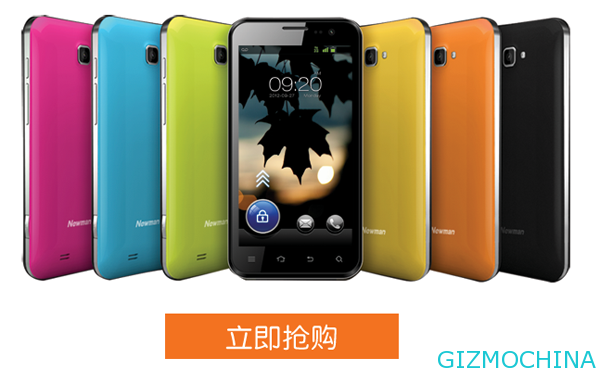
Newman N2 is new quad-core Android phone, with high cost-effective specification, Newman N2 has 4.7-inch IPS HD screen, 1.5GHz Samsung Exynos 4412 processor, 1GB RAM, 13-megapixel rear camera, and installed original Android 4.0 OS. There is only 1000 units Newman N2 engineering phone at first batch, the price is only RMB1499 ($240).
TheFXICotton Candy is a tiny computer that’s about the size of a USB flash drive. One one side is a USB port, and on the other is an HDMI connector. And in between there’s a 1.2 GHz Samsung Exynos 4210 dual-core processor, 1GB of RAM, and ARM Mali 400 graphics.
It’s been a little over a year since FXI first introduced the Cotton Candy, and in that time we’ve seen dozens ofcheap Android devicesthat you can plug into a television, some costing less than $50. But FXIcharges $199 for the Cotton Candy.
I caught up with FXI CEO Borgar Ljosland recently and had a chance to ask him what sets the Cotton Candy apart.
Surprisingly, Ljosland actually seemed excited when I brought up the competition. That’s because they’re helping to popularize the idea of a portable device that you can plug into any TV to run Android apps on a big screen.
But the Cotton Candy does a few things that most of those devices don’t.
First, FXI calls its device an “any screen” computer. That’s because it doesn’t just work with televisions or monitors. You can also plug it into a Mac, Windows, or Linux computer to run Android apps on a PC. Sort of.
What actually happens is that the computer treats the Cotton Candy as a standard USB drive. But on that drive there are apps for OS X, Linux, and Windows that launch virtualization software, letting you basically login remotely to the Cotton Candy without leaving your desktop environment.
In other words, it’s still that Exynos processor and Mali Graphics chip that’s doing the heavy lifting, not your computer’s processor. Any apps you’re using are runnin on the stick. But you’ll see them in a window on your computer. The process is pretty seamless and Android apps looked pretty responsive in the Mac and Windows computers Ljosland showed me.
Another thing that helps set the Cotton Candy apart is that it’s not limited to running Android. We’ve seen plenty of independent developers port Ubuntu and other Linux distributions torun on cheap mini PCs like the MK802. But FXI officially supports Ubuntu as well as Android 4.0.
So if you buy an FXI Cotton Candy stick, you have a choice of using it to run Ubuntu or Android. Right now that means Android 4.0 or Ubuntu 12.04, although FXI could release updates for either operating system… or independent developers could do the same.
Right now, Ljosland says there are 160 different companies trying out the Cotton Candy, either to see if they can use it in their businesses or to develop applications that run on top of it.
At this point, the company is targeting the device at developers, which is another reason for the $199 price tag. Anyone can pick up the stick-sized-computer and use it for non-development purposes, but it’s not really meant to be a consumer device just yet.
On the other hand, if you’re a company with a large number of employers that may need to use different computers at different locations, this sort of solution would let you give each user a computer that they can fit in their pocket. It would store all of their files, settings, and apps, and they could pick up where they left off by plugging the device into any PC or display.
Ljosland also seems convinced that the Cotton Candy offers better performance than many of the cheap Chinese sticks we’ve seen, but that’s probably a matter that’s up for debate. It basically has the same guts as a Samsung Galaxy S II smartphone, which is a bit dated at this point.
The stick features WiFi and Bluetooth support and FXI ships it with an 8GB microSD card — which is the only storage the Cotton Candy has. There’s no built-in storage space.
Here’s a recap of what you get with the $199 Cotton Candy stick:
1.2 GHz Samsung Exynos 4210 dual core ARM Cortex-A9 processor
quad-core ARM Mali 400 graphics
1GB RAM
microSD card slot for up to 64GB of storage
802.11b/g/n WiFi
Bluetooth 2.1
USB 2.0 male port
HDMI port
micro USB port
You can keep up with the software development, and see more of what people are doing with the Cotton Candy in theFXI forums.