Showing posts with label intel atom phone. Show all posts

CES 2013: Lenovo K800 With Intel Atom Makes Appearance At Intel Booth.

Tuesday, 8 January 2013


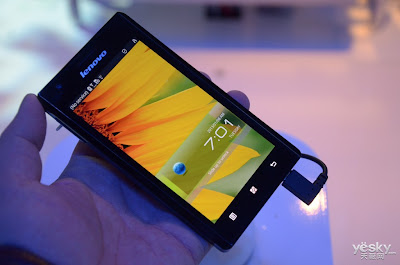
At the CES 2013, Lenovo K800 quietly appears at the Intel booth instead of Lenovo booth. It was the first Intel powered smartphone that launched in China. 


Lenovo K800 features a 4.5-inch display with 720p HD resolution, Android 4.0 Ice Cream Sandwich, 8-megapixels of rear camera, 1.3-megapixels of front camera, bluetooth, WiFi and others. 

The main attention is this Lenovo K800 powered by 1.6GHz Intel Atom Z2460 processor and 1GB of RAM. The appearance of Lenovo K800 allows Intel to showcase more devices that powered its mobile processor. 

Intel wants to launch 48-core chips for phones… tablets within a decade

Wednesday, 31 October 2012


Intel logoIntel is just starting to get its feet wet in the smartphone space thanks to new low power Atom processors. But one day the chip maker hopes to ship 48-core microprocessors designed for smartphones and tablets.
And according to ComputerWorld, that day is around 5 to 10 years away.
If you look at the pace of advancements over the past few years that goal seems pretty reasonable. In fact, by the time 48-core smartphone chips are available, they probably won’t seem all that revolutionary. After all we’ve moved from single core to quad-core chips in mobile devices in just the last few years.
In fact, it’s only been about 5 years since the first iPhone went on sale, and today that device looks pretty dated.
While 48 processors cores might sound like overkill, there are good reasons to add multi-core capabilities to chips. It allows a phone, tablet, or other device to execute multiple instructions simultaneously without sharing resources. This leads to faster performance, better support for multitasking, and lower power consumption (since multiple cores can run at lower voltages than a single core trying to perform multiple tasks at once).
That doesn’t just mean it’ll be easier to listen to music while surfing the web. Applications designed to take advantage of multi-core chips could benefit as well. For instance games could use different processor cores to render different graphics effects, or a video player could decode multiple video frames at once.
While Intel marches towards 48-cores, I don’t expect competitors ARM or AMD to sit still. All told, the phone and tablet space could look as different 5 years from now as it did the day before the iPhone was unveiled.

News : Upcoming @ZTE #GRAND_X will be running on Intel

Saturday, 1 September 2012

ZTE Grand X has recently launched, and  today ZTE announced that it will launch the new version of ZTE Grand X will be powered by Intel processors. The new version will be named the ZTE Grand X IN.

ZTE Grand X IN, a new version of the Grand X based on Intel’s processor architecture. Using Intel Atom Z2460 processor. In addition,  It runs on Android Ice Cream Sandwich 4.0 and features a 4.3-inch qHD capacitive touchscreen with a 960×540 pixel resolution.
Meanwhile the Intel XMM 6260 hardware means it can support HSPA+ high-speed data connectivity and a 1,650mAh battery pack keeps things ticking over. Other features include an 8-megapixel primary camera with flash, 1GB of RAM, Micro SD support, NFC, GPS, DLNA, Wi-Fi, Wi-Fi Direct and Bluetooth.
Until now, there is no information from ZTE about price, availability and whos the OEM manufacturer for this smartphone production.

News|Intel Atom based smartphones to go on sale starting tomorrow

Wednesday, 18 April 2012

Intel CEO Paul Otellini announced during a financial earnings call that the company's first Atom based smartphone will go on sale "later this week".
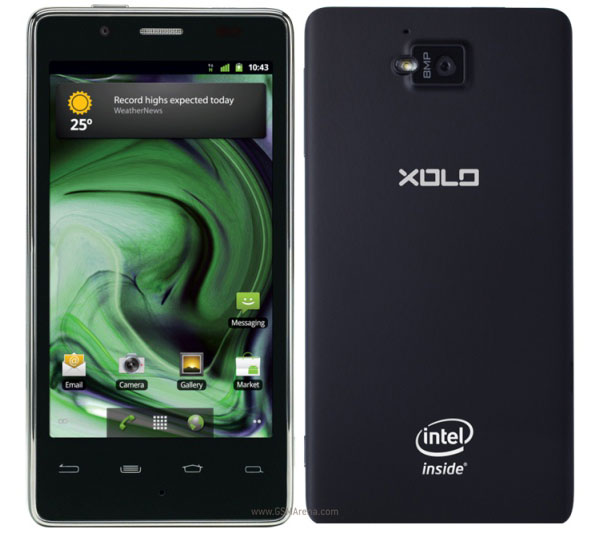
This is not really a surprise because the Indian company Lava, with whom Intel partnered to make Atom based Android phones, has already announced their intentions to launch the Xolo X900 tomorrow, April 19, in India.

Just in case you are not aware of this phone, it has a 4.03-inch display with 1024 x 600 resolution (295 PPI), 8 megapixel rear camera with flash, 10fps burst mode and 1080p video recording, 1.3 megapixel front camera, 1GB RAM, 16GB internal storage space, HSPA+ connectivity up to 21Mbps, HDMI out and NFC built-in. Unfortunately, the phone will be sold with Android 2.3 Gingerbread at launch.
The Xolo X900 will use Intel's Atom Z2460 processor that has a single-core 1.6GHz Saltwell CPU with Hyper-Threading, PowerVR SGX540 GPU clocked at 400MHz and 32-bit Dual channel LPDDR2 memory. This processor, however, is based on Intel's x86 architecture that differs from the one that ARM uses on almost every other SoC on the market, which means application compatibility is going to be an issue initially.
No price has been mentioned so far for this device although we expect it to be around $500 unlocked, considering Lava's reputation for not being a premium brand.
Unfortunately, the rest of the world will have to wait for now, because even the Lenovo K800 is slated to launch only in China.

Intel Atom-packing Orange Santa Clara benchmarked

Saturday, 10 March 2012

Intel are serious about getting into the mobile phone business with phones like the Orange Santa Clara. The Intel Atom Z2460 chipset however drew some ridicule for its single CPU core.
Early benchmarks show, however, that the single (but HyperThreading-capable) core packs a lot of punch. A lucky CeBIT visitor had a chance to run a couple of browser-based benchmarks, which are easier to access than dedicated apps.
The Santa Clara scored nearly 90K on BrowserMark, beating an iPhone 4S by a slight margin. The Samsung Galaxy Nexus, which uses the highly-optimized Android 4.0 ICS browser, scores over 100K on this benchmark, but the Santa Clara is still on Gingerbread and should see its scores jump after the planned ICS update.
 
Orange Santa Clara vs. iPhone 4S in BrowserMark
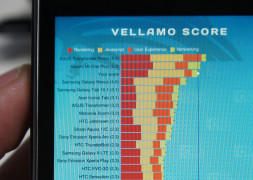
The Intel-based droid also posted some impressive scores on Vellamo. It managed to outpace the Galaxy Nexus and placed behind the quad-core Asus Transformer Prime and the dual-core Xiaomi Mi-One Plus.
  
Santa Clara's Vellamo benchmark
The Orange Santa Clara used for these tests ran Android 2.3.7 Gingerbread and its Atom CPU was reportedly clocked at 1.4GHz. Browser-based benchmarks are not the best at pushing several CPUs to their limit (and much less when it comes to the GPU), but these are pretty encouraging results, especially with a dual-core Atom chipset on the way.

News : Intel announce two new Atom CPUs for phones and tablets

Tuesday, 28 February 2012

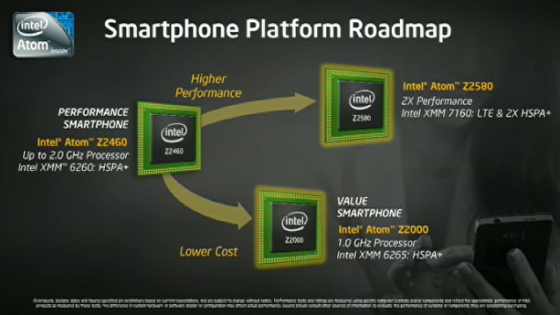
Intel is serious about getting a piece of the handheld action this time - they announced two new processors and chipsets to join what's already powering the likes of the Lenovo K800 and the Orange Santa Clara.


The first processor is called Atom Z2580 and features two cores (the same Medfield design like the fist one) with HyperThreading allowing the processor to run four threads simultaneously. It will be clocked at 1.3GHz, potentially going up to 1.8GHz with Turbo Boosts.
It's paired with a powerful GPU too - PowerVR SGX544MP2, which is supposed to double the performance of an SGX543MP2 found in the iPhone 4S.
Intel have their own LTE-capable modem that will work with the Atom Z2580 and all these components will be shown off in a brand new reference design.
With a little luck, it will go the way of the Santa Clara and be offered as a consumer phone too. However, that's unlikely to happen before the first half of 2013 at the earliest .
The second chipset includes the Atom Z2000, a low-end single-core processor running at 1GHz and without HyperThreading. There's a downclocked SGX540 GPU and an Intel-made HSPA+ modem.
The Atom Z2000 will get its own reference design and will target low-end phones. There's no word on availability, but probably won't be soon either.

Intel's Medfield series processor debuts on the Lenovo K800

Wednesday, 11 January 2012


Intel has been trying to get into the smartphone segment for a long time now but they have finally managed to do it with the Lenovo K800, which will be the first smartphone to hit the market running on Intel's 32nm Medfield platform.
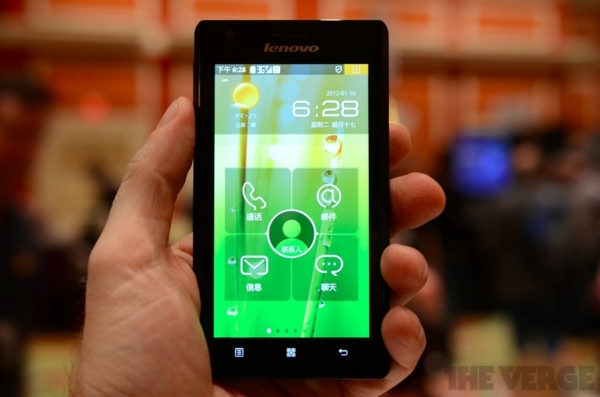
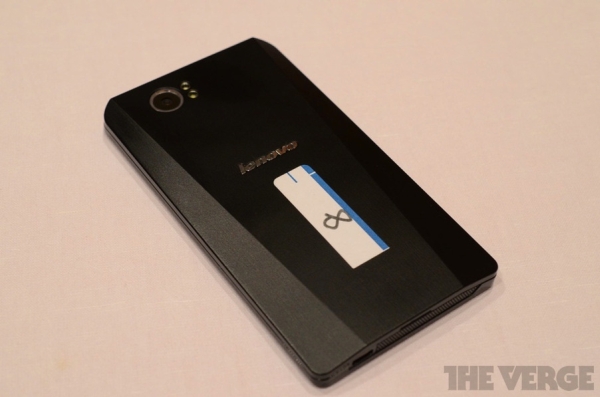
The K800 is running on the Penwell SoC that has a 1.6GHz Intel Atom Z2460 CPU with 512KB L2 cache. On the GPU side it has the tried and tested PowerVR SGX 540 which has been clocked at a slightly higher than usual 400MHz and dual-channel LPDDR2 memory. The CPU in Penwell is only a single-core right now but Intel plans to come up with dual-core versions later, along with a faster GPU.
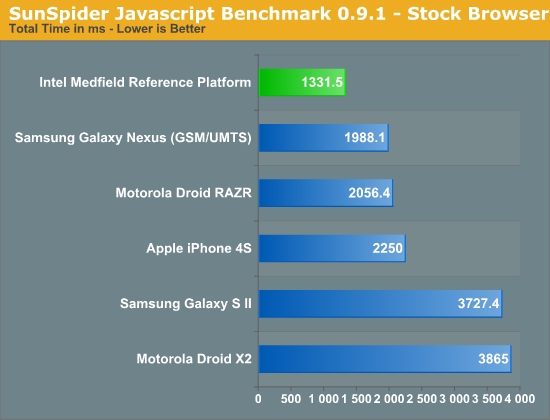
So how does this new chip perform? Quite well, actually. Despite the single-core CPU and the fact that the K800 was running on Gingerbread, the Intel chip managed to race past phones like the Galaxy Nexus running ICS and the iPhone 4S in the browser benchmarks. GPU benchmarks, admittedly, weren't as impressive, although it is powerful enough to decode and encode 1080p30 video.
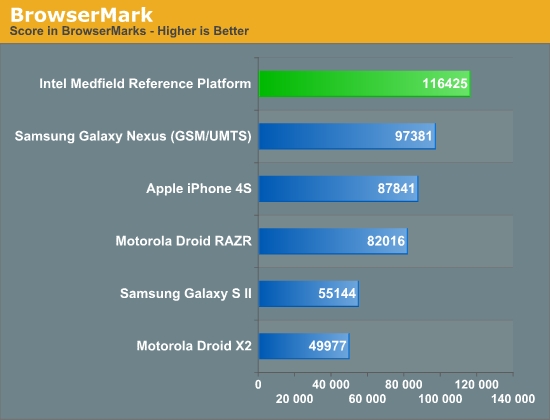
But what about power consumption, you ask? Luckily, Intel has taken care of that as well. Compared to phones like the iPhone 4S, Galaxy S II, HTC Sensation and the LG Optimus 2x, the Intel reference handset managed to consume the least amount of power in certain tasks while being significantly lower in some of the others.

It is important to note, however, that despite the impressive CPU performance and lower power consumption, the Medfield processor is up against rivals that came out last year and are soon to be upgraded. It remains to be seen how well it stacks up against the Cortex A15 and the Qualcomm Krait when they release later this year.
Intel has managed to partner with two companies for now, one of which is Lenovo and the other is Motorola. Lenovo plans to launch the K800 in China by Q2 this year although the Motorola smartphones and tablets running Medfield will only arrive by the end of this year.

 
DroidXDA © 2012 | Designed by Bubble Shooter