Showing posts with label Arm. Show all posts

Raspberry Pi adds MPEG-2, VC-1 support for media center users… for a fee

Sunday, 26 August 2012

The Raspberry Pi is a tiny, inexpensive computer that was originally designed for education institutions. The idea was that if the developers could make a mini PC available for $25 to $35, it would make it easier for teachers and students to learn programming, access the internet, and perform other basic computing tasks.
But ever since the makers of the Raspberry Pi started offering limited quantities to early adopters and hobbyists, people have been doing otherthings with the little computers — like using them as cheap media center PCs.
Raspberry Pi
While the Raspberry Pi ships with support for decoding H.264 video, it doesn’tsupport some other popular video codecs, including MPEG-2 and VC-1. That’s not because the hardware can’t handle those formats, but because the developers didn’t want to drive up the price of the hardware by paying license fees.
Now Raspberry Pi has announced that anyone who wants support for those codecs can pay extra to enable them. An MPEG-2 license is available for $3.79, and VC-1 codec support runs $1.90.
When you buy the license, you’ll receive a download that’s tied to your Raspberry Pi device’s serial number. This solution makes the video format support available to those that want it, while keeping the overall price of the hardware low for those that don’t need it.
The developer behind Raspbmc, an operating system based on XBMC Media Center, says that now that MPEG-2 support is available future versions of the operating system will add personal video recorder features.
Developers are also adding H.264 encoding support for free, and announcing that several of the most popular media-centric operating systems for the Raspberry Pi now include CEC support, letting you control a Raspberry pi computer, an HDTV, and other devices using a single IR remote control.

ARM unveils Mali 450 graphics for mid-range phones

Friday, 15 June 2012


Products with ARM’s next-generation Mali-T604 and Mali-T658 graphics are expected to ship later this year, offering higher performance graphics for smartphones, tablets and other high-end mobile devices.
But ARM also has plans to bring better graphics to mid-range smartphones and tablets.
The company’s new Mali-450 design basically offers up to twice the performance of ARM’s existing Mali-400 graphics by doubling the top number of cores available from 4 to 8.
ARM Mali-450 roadmap
Mali 400 graphics are currently used in dozens of Android phones and tablets, and will likely continue to stick around for a while.
According to EETimes,  Mali-400 graphics with between 1 and 4 processor cores will be sufficient for lighter tasks, while the Mali-450 with 5 to 8 graphics cores can be used in higher end devices.
via reddit

News|ARM reveals a new low-power quad-core Cortex-A15 variant

Wednesday, 18 April 2012

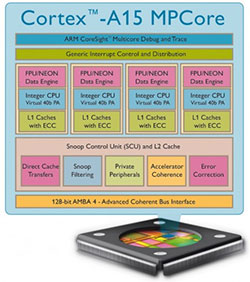
Chip design company ARM, famous for its Cortex A-series of processors, today introduced a new low-power design of its quad-core Cortex-A15 chip. Its main purpose is to help system-on-a-chip manufacturers design their products faster and with lower power use.
This will be achieved using the company's new hard macrocell implementations of the Cortex A-series of processors. Those versions will boast four cores clocked at 2GHz based on a 28nm design that have fixed specifications. This means that companies using those "hard macro" implementations will not be able to heavily customize ARM's design to their liking.
As a result, manufacturers will get the same power usage as earlier Cortex-A9 chips and faster turnaround times for their SoCs, since they won't be able to fiddle with them. ARM says this will bring "balance of performance and power", which could eventually be used even in notebooks or fast network devices such as smart routers.
ARM is expected to reveal more details on their new work at tomorrow's IEEE symposium in Yokohama. Chips are expected to start shipping as early as the end of 2012.
It's not yet clear how this would reflect on various manufacturers, but it's certainly going to give them the option to quickly utilize the Cortex-A15 processor, without spending too much time on its development to suite their own needs.
Source | Via

 
DroidXDA © 2012 | Designed by Bubble Shooter